The nasolacrimal duct, also known as the tear duct, carries tears from the lacrimal sac into the nasal cavity. The nasolacrimal duct begins in the eye socket between the maxillary and lacrimal bones. Nasolacrimal duct obstruction is blockage of the nasolacrimal duct, which presents with excessive tearing. This can predispose to secondary bacterial infection of the lacrimal sac, known as dacryocystitis. Treatment is often conservative, but may also require antibiotics or invasive interventions to relieve the obstruction.
Nasolacrimal duct obstruction. Image courtesy of Fort Worth Eye Associates.
Causes of nasolacrimal duct obstruction:
Congenital nasolacrimal duct obstruction is usually seen within 3 to 12 weeks of birth. Patients present with a history of excessive tearing (epiphora), either unilaterally or bilaterally. Epiphora is also present in acquired nasolacrimal duct obstruction.
Congenital nasolacrimal duct obstruction:
This is a clinical diagnosis. Probing of the duct may help identify the site of obstruction and help relieve the obstruction. Presence of ocular infection is a contraindication to probing.
Acquired nasolacrimal duct obstruction:
This is also a clinical diagnosis. Reflux when probing and irrigating the lacrimal drainage system with saline, with or without fluorescein dye, indicates stenosis of the lacrimal apparatus.
Congenital lacrimal duct obstruction:
This condition usually resolves spontaneously by around 9 months of age. Before 12 months of age, management is conservative and involves lacrimal sac massage. In infants with persistent epiphora despite lacrimal sac massage, lacrimal duct probing can be used to determine the site of obstruction and relieve the obstruction. This is usually performed in infants older than 12 months of age, under general anaesthesia. Probing involves inserting a flexible metallic probe ranging from 0.7 mm to 1.10 mm in diameter through the lacrimal punctum after dilating the punctum.
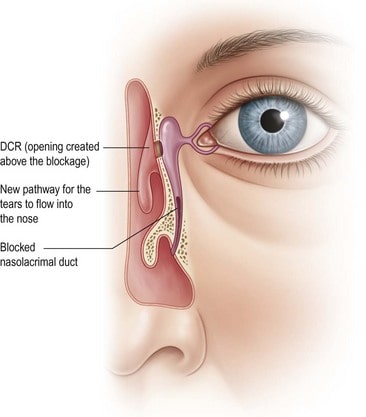
Other interventions include dilation or stenting of the obstructed nasolacrimal duct. If other measures fail, endoscopic dacryocystorhinostomy may be considered. This is where a passage is created between the lacrimal sac and the nasal cavity surgically, to provide a new pathway for tears to drain.

Dacryocystorhinostomy is a surgical procedure which creates a new path for tears to drain. Image courtesy of Prasadnetralaya.
Acquired nasolacrimal duct obstruction: